
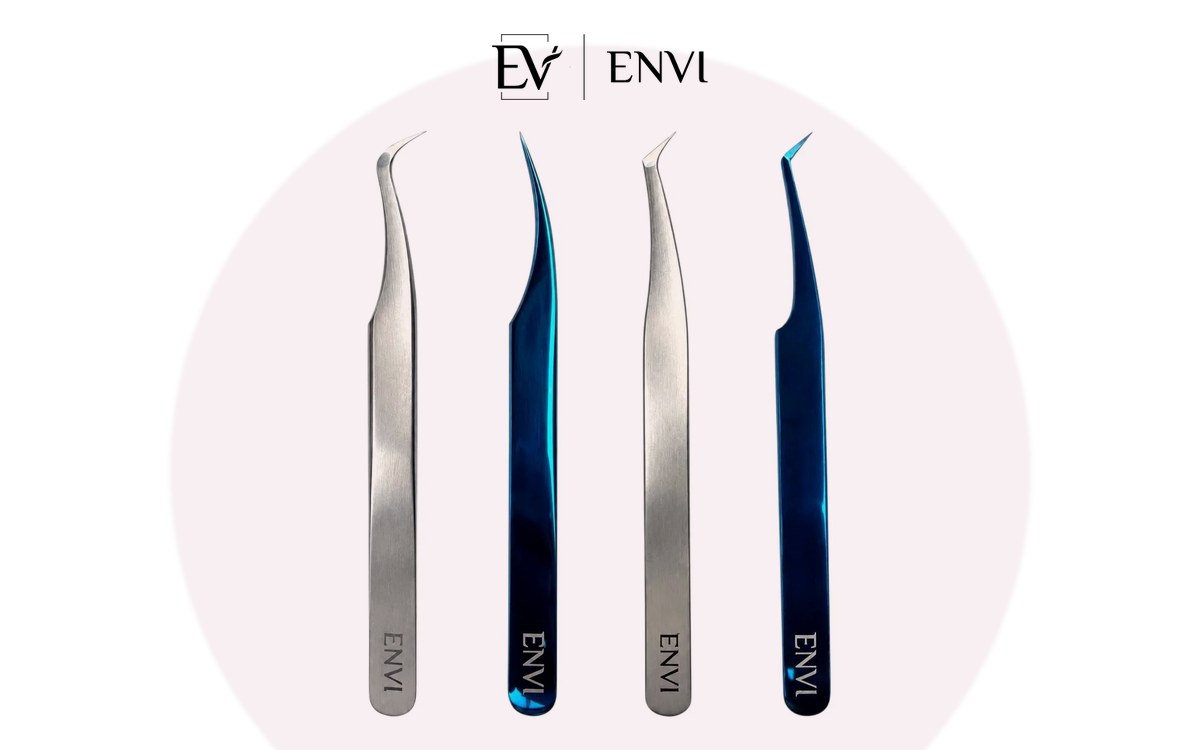
Good tweezers save time on every service and spare your hand. Here is which tweezers you need, how the shapes differ and how to test tweezers before you start working with them.
Two tweezers, two jobs
Lash work uses both hands. One hand holds isolation tweezers, which separate one natural lash from its neighbours. The other holds working tweezers, which pick up the extension or build a fan and place it on the natural lash. Precise isolation is the base of good retention: lashes stuck together shed quickly and harm the natural lashes.
Shapes and what each is for
- Straight fine: the classic isolation shape. Reaches deep between lashes and keeps your view open.
- Dolphin: for isolation, with a slightly curved tip that helps at the inner corner and with short lashes.
- L at 45°: an all-round working tweezer for classic and light volume. Comfortable for beginners.
- L at 65°: a sharper bend; handy for placing at awkward angles and for building fans.
- 75° and 90°: for building volume fans, by hand or from the strip, and for artists used to this grip.
- Long tip (9–11 mm): a larger contact area for picking up wide fans.
What to check
- Tip closure. The tips should meet exactly along 1–2 mm, with no gap and no crossing. A simple test: pick up a single 0.07 lash from the strip. If it twists or slips, the closure is poor.
- Working tip length. A short tip (5 mm) gives control in classic work; a long tip (7–11 mm) suits fans.
- Grip surface. A diamond-grit coating (Diamond series) holds the lash without hard pressure. Laser sharpening (Laser series) gives a fine, precise tip.
- Pressure and weight. Light closing pressure and balanced weight reduce hand fatigue over a working day. ENVI tweezers weigh 16–19 g.
ENVI models by purpose
| Model | Angle | Tip (mm) | Main use |
|---|---|---|---|
| Diamond Straight Fine / Laser Straight Fine | — | — | isolation |
| Diamond Dolphin / Laser Dolphin | — | — | isolation |
| Diamond L45 / Laser L45 | 45° | 5 | classic and light volume |
| Diamond L45 / Laser L45 | 45° | 7 | classic and light volume |
| Diamond L65 / Laser L65 | 65° | 5 | classic and light volume |
| Diamond L65 / Laser L65 | 65° | 7 | volume and fans |
| Diamond Comfort L / Laser Comfort L | — | 8 | volume and fans |
| Diamond T3-75 / Laser T3-75 | 75° | 7 | volume and fans |
| Diamond T3-90 / Laser T3-90 | 90° | 7 | volume and fans |
| Diamond T2-75 / Laser T2-75 | 75° | 9 | volume and fans |
| Diamond T3-45 / Laser T3-45 | 45° | 9 | volume and fans |
| Diamond Perfect S / Laser Perfect S | — | 11 | volume and fans |
Figures are from the product pages. Every model works for both classic and volume; the last column shows what each is especially comfortable for.
A recommended set
- Beginners: Straight Fine or Dolphin for isolation and L45 with a 5 mm tip for placement.
- Classic and light volume: isolation + L45 or Comfort L.
- Volume: isolation + L65, T3-90 or Perfect S for building fans.
Care and storage
After each client, clean adhesive residue off the tweezers and disinfect them; at the end of the day, sterilise them following the manufacturer's instructions. Equipment is in disinfection and sterilisation. Store them with tip caps and protect them from drops: one knock is enough to spoil the closure. Do not use your working tweezers to clear glue from the bottle nozzle.
All tweezers are in lash extension tweezers. Before you start, it is also worth reading which glue suits heat and humidity.